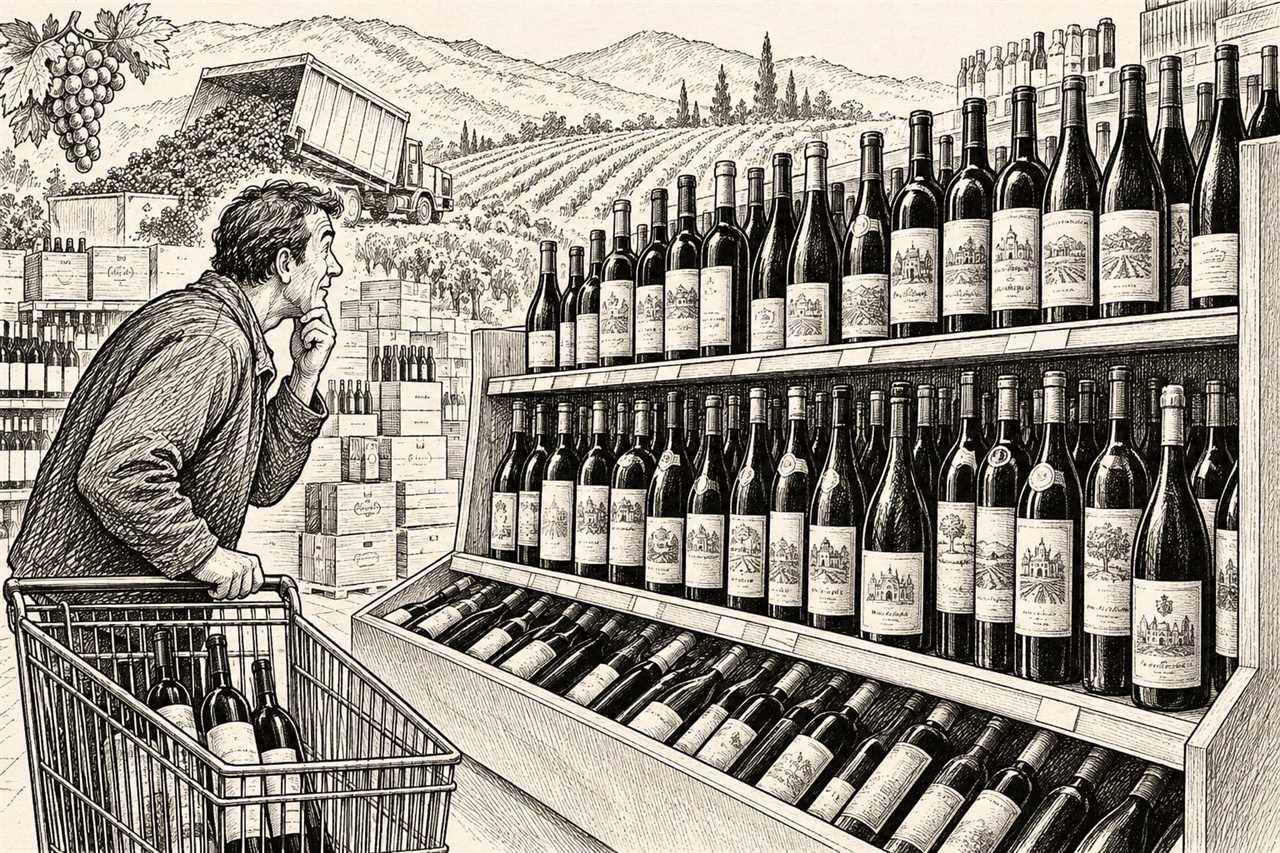
A surplus of California wine is reshaping shelves at major retailers including Costco, Kroger, Aldi and Grocery Outlet, where high-scoring wines are now appearing under store and exclusive labels at steep discounts. Industry buyers say the shift has accelerated over the past two years as wineries work through excess inventory built up from prior seasons.
The trend matters for shoppers because it means bottles that once carried triple-digit price tags under a winery's own label can now be found for a fraction of the cost. For a site that follows consumer economy trends closely, this staff reporter has tracked the story because it touches everyday spending decisions at the grocery store, and because the window for these deals may not stay open long.
Curtis Mann, a vice president who oversees wine, beer and spirits at Kroger, said the quality jump has been striking. He said Kroger's portfolio went from having no wines rated 90 points or higher by respected reviewers to 20 such wines in the last two months.
Buyers describe similar jumps elsewhere. Taylor Case, president of Navigator Wine Collection, said he recently tasted a Napa Valley cabernet that carries a $149 retail price under its original label. Navigator plans to sell the same wine for $29.99. "I'm shocked at what we do sometimes," Case said. He added, "I would not want to be a grower right now," and noted, "There's a ton of wine that's still on the market." Navigator runs private-label lines including Gearbox, Motif and Decoded.
At Grocery Outlet, Steve Beckner, who buys direct imports and private-label wine, said he has not seen anything like the current surplus in his nearly 30 years in the business. "I'm trying to find the words to describe it," he said. "The quality has gone up exponentially." He pointed to a Napa Valley cabernet sauvignon that might normally sell for $45 to $85 under its own brand, now appearing for $9.99 as Second Cheapest Wine, the chain's house label. Grocery Outlet operates more than 500 stores across 16 states.
The scale of the surplus
The size of bulk wine deals has grown sharply. Beckner said when he joined Grocery Outlet in 2018, typical offers ran between 1,000 and 3,000 cases. He said he is now seeing pitches ranging from 20,000 to 200,000 cases, a volume that explains how costly wine ends up in bottles priced under $10.
Wineries facing surplus have several options. Some run closeout sales under their own brand. Others sell bulk wine to third parties who bottle it, including supermarket chains and retailers like Total Wine & More. Remaining inventory may be stored, blended into future releases, or discarded. Retail store brands often do not disclose where the wine originates. Beckner said producers with a $100 cabernet who need to offload wine that did not make their flagship release often prefer that connection stay quiet if it ends up in a $9.99 bottle.
Price cuts are visible on store shelves. Costco said it lowered the price of its Kirkland Signature Stags Leap Cabernet Sauvignon to $19.99 from $22.99. Andrew Cullen, who reviews wines sold at Costco from Atlanta, said shoppers are "getting access to maybe some of the best winemakers in the world for 20 bucks a bottle." He called the situation "insane."
Rob McMillan, executive vice president of Silicon Valley Bank's wine division, discussed the trend in a videocast tied to the bank's 2026 State of the US Wine Industry report. He said private label is "the one thing that is growing" at retailers such as Costco, Kroger and Aldi. He added that those retailers "are all selling wine" and "doing something right." The report described the pattern as a form of discounting that draws in value-focused buyers, protects brand value for producers, and helps work through the backlog of bulk wine.
Why the glut built up
Several factors have slowed wine consumption in California and other parts of the country. These include consumers drinking less alcohol overall, the rise of GLP-1 weight loss drugs, and inflation pressuring household budgets. According to Turrentine Brokerage's August 2026 wine market report, even after what it called "drastic, necessary actions" to address the imbalance, the surplus built up in prior years still needs to work its way through the system.
Producers are adjusting their output. Kerith Overstreet, founder of Bruliam Wines in Windsor, California, said she intentionally scaled back production this year. She said unpredictable weather has also reduced yields across the region, with her Russian River Valley vineyard producing 30% less than its 2024 peak. She described the drop as "a divine market correction" and said the wine business is "definitely cyclical."
Some winemakers are taking more drastic steps to speed the correction, including removing vines from their land, switching to other crops, or simply cutting production further. Case said he expects supply and demand to realign within the next one to two years. "It's still going to take another 12 to 24 months to completely clear up," he said. He added, "Supply and demand always find each other."
What it means for shoppers
For now, buyers are benefiting. Peter Baedeker, owner of Baedeker Wine in Santa Barbara, called the current climate "probably one of the best times I've seen in my near 30-year history in the industry for the consumer." Private-label deals work well for everyday drinking, though some shoppers still want a known brand name for special occasions. Steph Marr, a director at a Boston advertising technology company, said she is comfortable buying store-brand wine for casual drinking, but for gifts, "I want it to feel like a special thing."
The practical effect for household budgets is that high-quality wine is currently cheaper than usual at familiar stores. That could change as producers take steps to shrink supply. Buyers following the market say the current discounts may not last, since efforts to correct the glut are already underway at wineries across the state.
Earlier in this series: Trump Pauses 50% Tariffs on Canada as Trade Talks Advance